Disposable Cup Thermoforming Machine Prices and Manufacturing Advantages of Turkish Suppliers
The disposable cup thermoforming machine price is an important consideration for packaging manufacturers planning to establish new production facilities, expand existing operations, or replace outdated equipment. However, the initial purchase price represents only one part of the investment. Machine configuration, forming capacity, material compatibility, automation technology, tooling requirements, energy consumption, and long-term maintenance expenses collectively determine the financial performance of a production line. For manufacturers evaluating equipment suppliers, understanding these variables is essential to making an investment that supports sustainable operational profitability.
Table of Contents
Turkey has developed a competitive position in industrial machinery manufacturing, offering international buyers access to engineering expertise, flexible equipment configurations, and export-oriented production capabilities. Companies involved in disposable cup production increasingly evaluate Turkish manufacturers alongside established European and Asian suppliers. The objective is not simply to purchase equipment at the lowest possible price but to identify machinery capable of maintaining production consistency, minimizing material waste, and supporting predictable manufacturing costs throughout its operational life.
For businesses entering plastic cup manufacturing, selecting the appropriate equipment requires a detailed assessment of intended products, production volumes, material specifications, and factory infrastructure. A machine suitable for producing standard drinking cups may not provide the same economic performance when manufacturing larger containers or technically demanding packaging products. Understanding these differences before requesting quotations helps manufacturers establish realistic investment expectations and avoid expensive equipment modifications after installation.

Disposable Cup Thermoforming Machine Prices and Manufacturing Advantages of Turkish Suppliers
What Determines the Price of a Disposable Cup Thermoforming Machine?
The purchase price of a cup forming machine depends primarily on its mechanical architecture, forming area, production speed, automation level, and integrated control systems. Industrial equipment designed for continuous production typically incorporates precision forming mechanisms, servo-driven components, controlled heating systems, and automated product handling. These technologies influence manufacturing costs because they determine how accurately the machine operates under demanding production conditions. Equipment designed for relatively simple applications may require a smaller initial investment, while systems configured for high-output production generally involve more sophisticated engineering.
Material processing requirements also influence equipment selection. PP cup production and PET cup production involve different thermal behavior, sheet characteristics, and forming conditions. Polypropylene requires careful control of its processing window, while PET applications demand appropriate heating and forming conditions to maintain product definition and consistency. A machine intended to process multiple materials may require additional configuration flexibility, depending on the product and equipment design. Buyers should therefore confirm the specific material compatibility of each proposed machine rather than assume that every thermoforming system processes all thermoplastics equally.
In practical equipment evaluations, one of the most common mistakes is comparing quotations without examining their technical scope. Two machines with similar forming dimensions may differ substantially in heating technology, servo systems, stacking arrangements, safety provisions, and automation capabilities. These differences directly affect cup manufacturing costs over time. A meaningful comparison requires a detailed technical specification, clearly defined equipment boundaries, and an understanding of which components are included in the quoted investment.
How Turkish Machinery Manufacturers Offer Competitive Equipment Investment Options?
Turkish industrial machinery manufacturers benefit from an established manufacturing ecosystem that includes mechanical engineering, metalworking, electrical integration, automation services, and industrial component sourcing. This environment allows Thermoforming machine manufacturers to develop equipment for international markets while offering configuration flexibility for different production requirements. For overseas buyers, the commercial advantage often comes from the relationship between technical capability, acquisition cost, customization, and access to manufacturer support.
The competitive position of Turkey Thermoforming machine manufacturers should be evaluated through measurable equipment specifications rather than country-of-origin assumptions. A supplier’s manufacturing infrastructure, engineering processes, component selection, installation capabilities, and technical documentation provide stronger indicators of equipment value than the quoted price alone. Internationally recognized automation components can also simplify technical familiarization for maintenance teams already experienced with established industrial control platforms.
For buyers considering Turkish disposable cup machine suppliers, our recommendation is to establish the production specification before discussing final commercial terms. The target cup dimensions, material grade, expected output, sheet thickness, available utilities, and downstream handling requirements should be documented. This approach allows manufacturers to propose equipment configurations based on actual operating conditions, reducing the likelihood of unnecessary features or insufficient production capability. Turkish suppliers are particularly worth evaluating when buyers require application-specific engineering and direct communication with the equipment manufacturer.
Comparing Disposable Cup Thermoforming Machine Prices Across Turkey, China and Europe
Comparing equipment sourced from Turkey, China, and Europe requires more than reviewing purchase quotations. Chinese manufacturers offer a broad range of plastic packaging machines, including entry-level systems and highly automated industrial production equipment. European suppliers may offer specialized engineering solutions with extensive automation and documentation packages. Turkish manufacturers occupy a competitive position for buyers seeking industrial production capabilities, equipment customization, and direct manufacturer involvement. Actual differences depend on the individual supplier, machine configuration, and commercial agreement.
The plastic cup thermoforming equipment price should be compared using equivalent technical specifications. Forming area, material compatibility, achievable production cycles, tooling provisions, heating capacity, stacking equipment, electrical requirements, and included commissioning services must be examined together. A lower quotation may exclude molds, auxiliary equipment, transportation, installation, or operator training. Conversely, a higher quotation may include equipment and services that reduce additional expenditure during production startup.
Our experience-based approach to international equipment comparisons is to calculate the total landed and commissioned investment. This includes machinery acquisition, freight, insurance, customs-related expenses, installation, tooling, spare parts, and initial production validation. For Turkish Thermoforming machine manufacturers, competitiveness is best demonstrated through transparent specifications and documented commercial scope. Buyers should also compare warranty conditions, technical response arrangements, spare-part availability, and the expected cost of maintaining equipment in their destination country.
The Impact of Machine Automation and Production Capacity on Equipment Costs
Automation substantially influences the financial structure of industrial thermoforming equipment. Modern Thermoforming machines may incorporate servo-driven sheet transportation, programmable forming sequences, automatic lubrication, precision heating controls, and integrated stacking systems. These functions are intended to improve repeatability, reduce dependence on manual adjustments, and support consistent production cycles. However, additional automation increases equipment complexity and can raise the initial investment, making it important to match automation capabilities with realistic production requirements.
For manufacturers evaluating high-speed thermoforming, the advertised cycle rate should never be interpreted as guaranteed finished-product output. Actual production depends on mold cavity count, material characteristics, forming depth, cooling requirements, product geometry, and downstream handling capacity. A machine operating at 30 cycles per minute with 20 cavities theoretically forms 600 cups per minute before losses. Nevertheless, accepted output will be lower when startup waste, rejected products, interruptions, and planned maintenance are considered. The machine’s demonstrated performance with the intended product is therefore more meaningful than an isolated maximum-speed figure.
An automatic cup forming machine price comparison should also account for labor requirements and operational stability. Automation is particularly valuable in facilities operating multiple shifts or handling substantial production volumes. Smaller manufacturers with limited demand may find that a moderately configured machine offers a better financial return than the highest-capacity alternative. The most appropriate high-speed cup thermoforming equipment is not necessarily the fastest available system, but the one whose usable output aligns with production orders, staffing capacity, and downstream packaging operations.

Disposable Cup Thermoforming Machine Prices and Manufacturing Advantages of Turkish Suppliers
How Mold Specifications and Cup Dimensions Influence Thermoforming Machine Investment?
Mold engineering is one of the most important technical variables in Thermoforming machine production and equipment configuration. Cup diameter, height, wall thickness, rim geometry, draft angle, and required dimensional tolerances influence mold layout and forming conditions. A shallow drinking cup and a deep container may require different material distribution strategies, cooling arrangements, and forming assistance. The machine must provide sufficient forming depth, appropriate tooling dimensions, and suitable mechanical capability for the intended application.
Cavity arrangement directly affects manufacturing economics. Increasing the number of cavities can improve theoretical output per cycle, but only when the forming area, sheet utilization, heating capacity, and product separation system support the proposed layout. An inefficient cavity arrangement can increase trim waste and material consumption, potentially offsetting the benefit of higher production volume. In practical projects, tooling design should be assessed alongside the machine rather than treated as a separate purchasing decision.
For industrial plastic cup production machinery, mold specifications should be finalized through cooperation between the equipment manufacturer, tooling provider, and packaging producer. Buyers frequently underestimate the impact of future product changes. A production facility planning several cup sizes should examine mold-change procedures, setup time, compatible tooling dimensions, and adjustment requirements. Equipment that accommodates planned product variations can provide greater long-term value, although tooling compatibility must be confirmed for each application.
Energy Consumption, Material Efficiency and Operating Expenses in Cup Manufacturing
Electricity and raw material consumption are significant contributors to thermoforming machine operating expenses. Heating systems must bring plastic sheet into an appropriate processing range, while mechanical drives, cooling equipment, compressed air systems, and auxiliary machinery contribute additional energy demand. Actual consumption varies according to machine configuration, material, product geometry, production speed, and operating conditions. For this reason, energy performance should be assessed under representative production conditions rather than through general efficiency claims.
Material efficiency is often more financially important than relatively small differences in electricity consumption. In food packaging machines, sheet thickness, mold arrangement, forming consistency, and trim recovery procedures can substantially affect material usage. Poor heating distribution or unsuitable forming parameters may produce uneven wall thickness, dimensional instability, or rejected cups. Servo-plug assistance and controlled heating can help improve material distribution when correctly configured for the application, but their effectiveness depends on the complete forming process.
For disposable cup production cost analysis, manufacturers should calculate material consumption using actual sheet input and accepted finished-product output. Where trim material can be recovered, its economic value depends on polymer type, contamination control, reprocessing capabilities, and applicable product requirements. A practical operating-cost assessment should include electricity, compressed air, cooling, labor, consumables, material losses, and maintenance. These calculations help distinguish equipment that appears economical during purchasing from equipment that remains economical during continuous production.
Calculating Production Cost per Cup with Industrial Thermoforming Equipment
The most useful financial indicator for evaluating disposable cup manufacturing machine cost is the cost of producing one accepted cup under normal operating conditions. This calculation should include raw material consumption, electricity, labor, tooling allocation, maintenance, factory overhead, and equipment depreciation. Manufacturers should also distinguish variable costs from fixed costs because production volume changes their contribution to each finished product. A machine operating below its planned utilization level can generate a significantly higher unit cost than expected.
Consider an illustrative facility producing 10 million accepted cups annually. If annual material expenditure is $180,000, electricity and utilities total $24,000, direct labor costs $60,000, and maintenance plus allocated overhead amounts to $36,000, annual operating expenditure reaches $300,000. The operating cost is therefore $0.03 per accepted cup before depreciation, financing, taxes, and distribution. If annual equipment depreciation adds $40,000, the modeled manufacturing cost becomes $0.034 per cup. These figures are hypothetical and demonstrate the calculation method rather than actual market pricing.
One frequent purchasing mistake is calculating cost using theoretical machine capacity instead of realistic annual output. In plastic cup manufacturing equipment Turkey procurement projects, buyers should request performance information relevant to their intended material and cup specifications. Startup losses, mold changes, scheduled downtime, and quality rejection rates must be incorporated into production forecasts. Sensitivity calculations using different utilization levels and raw material prices provide a more reliable basis for investment decisions than a single optimistic production scenario.
Understanding Maintenance, Spare Parts and Technical Service Expenses
Maintenance requirements influence the long-term economics of thermoforming machine investment cost. Industrial thermoforming equipment contains mechanical drives, forming mechanisms, transport chains, bearings, heating components, pneumatic systems, sensors, and electronic controls. These components require periodic inspection and maintenance according to their operating conditions. Equipment with accessible maintenance points, documented procedures, and appropriately selected industrial components can simplify routine servicing and reduce avoidable interruptions.
The quality of the technical support arrangement is particularly important for international buyers. A Thermoforming machine supplier should provide clear information about spare-part identification, troubleshooting procedures, electrical documentation, and service communication. Remote diagnostic capabilities can support fault identification and reduce the time required to determine corrective actions, although some failures still require physical inspection or component replacement. Buyers should confirm the availability and commercial terms of remote assistance rather than assume that all service activities are included in the equipment warranty.
In actual factory operations, preventive maintenance is usually more predictable and less disruptive than emergency repair. Manufacturers should evaluate the expected replacement intervals of wear components, availability of critical spare parts, and technical capabilities of their maintenance personnel. When comparing Turkish Thermoforming machine options with imported alternatives, service accessibility and parts logistics deserve the same attention as mechanical specifications. A production interruption can create costs through missed deliveries, idle labor, and lost capacity that exceed the immediate repair expense.
Evaluating Return on Investment Before Purchasing a Disposable Cup Thermoforming Machine
A proper thermoforming machine investment assessment should connect equipment performance with commercial demand. Buyers need reliable estimates of annual production volume, achievable selling prices, raw material costs, operating expenditure, financing requirements, and expected utilization. The investment model should also account for product demand fluctuations, production ramp-up periods, and planned tooling changes. A high-capacity machine can become financially inefficient when sales volumes are insufficient to support its available output.
For example, assume a manufacturer invests $500,000 in a complete production project and expects annual incremental operating cash flow of $125,000 after recurring operating expenses. The simplified payback period is four years. However, this calculation does not account for financing costs, taxes, working capital, major replacement expenditure, or the time value of money. A more comprehensive evaluation should include discounted cash flow, net present value, and internal rate of return under conservative and optimistic operating scenarios.
The automatic cup forming machine price should ultimately be judged against the machine’s expected contribution to production economics. High-volume manufacturers with established customers may justify advanced automation and larger forming capacity. Businesses testing a new market may benefit from a more conservative investment with suitable expansion potential. Before purchasing a Turkey Thermoforming machine, buyers should confirm product specifications, equipment capabilities, commissioning requirements, and realistic production assumptions. This reduces the risk of acquiring technically impressive machinery that does not match the commercial needs of the factory.

Disposable Cup Thermoforming Machine Prices and Manufacturing Advantages of Turkish Suppliers
How INPAK Helps Buyers Evaluate Thermoforming Machine Investment Requirements for Disposable Cup Production?
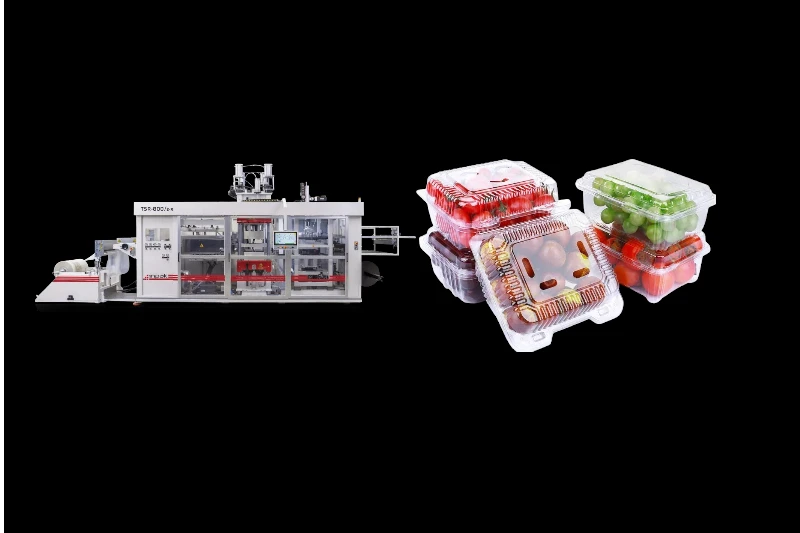
INPAK is among the Turkey Thermoforming machine manufacturers supplying industrial thermoforming technology for international packaging applications. Its equipment portfolio includes the TSR-800, TS-800, TS-850, and TS-1000 thermoforming machines, alongside pre-heating equipment and an elevator conveyor system. The company focuses on machine engineering and production technology rather than manufacturing finished packaging products. For prospective cup producers, the first step is identifying which equipment configuration can accommodate the intended material, cup dimensions, tooling requirements, and production targets.
INPAK’s Thermoforming machine manufacturing approach incorporates an ergonomic human-machine interface, proprietary control software, remote diagnostic access, adjustable HTS and HTSS Black ceramic heating configurations, automatic lubrication, and servo-driven sheet transportation. Depending on the equipment configuration, servo-plug assistance can support improved material distribution, while precision mechanical components and stacking arrangements contribute to controlled production operations. The company also uses components from established industrial suppliers, including B&R, Siemens, ABB, SEW, Omron, Schneider, Festo, SKF, and other specialized manufacturers. The suitability of individual features and materials must be verified for the selected machine model.
For businesses evaluating Turkish Thermoforming machine manufacturers, INPAK can be considered during the technical and commercial assessment of new production investments. Its equipment should be evaluated against actual cup specifications, required throughput, factory utilities, tooling compatibility, and operating-cost expectations. Buyers comparing Thermoforming machine manufacturers should request application-specific technical information and clarify the scope of molds, auxiliary equipment, commissioning, and after-sales support. As a manufacturer of industrial thermoforming systems, INPAK offers an equipment portfolio that prospective buyers can assess for disposable cup production and related packaging applications, subject to confirming the suitability of the selected configuration.