Automatic Capability Thermoforming Machines: How Automation Improves Production Consistency
Modern high-volume manufacturing demands flawless cycle repeatability, and integrating an automatic capability thermoforming machine into converting lines has fundamentally eliminated the unpredictable variance associated with manual machine tuning. Today, industrial Thermoforming machines operate as fully synchronized mechatronic ecosystems where thermal regulation, sheet indexation, forming kinetics, and stacking routines are governed in real time. In practical industrial operations, the most common situation encountered by packaging converters is batch-to-batch thickness variation resulting from slight ambient draft shifts or manual heating overrides. Through continuous sensor feedback and closed-loop servomotor drives, modern automation balances mechanical precision with process stability, ensuring that every packaging shell meets strict geometric tolerances regardless of production duration.
Table of Contents
The core transformation in plastic packaging machines lies in the transition from open-loop actuation to dynamic closed-loop response. When operators rely on conventional setups, minor mechanical play or thermal drift inevitably leads to thinning at deep-draw corners, distorted seal flanges, and erratic trim alignment. Based on our extensive engineering experience on the shop floor, implementing high-speed servo drives on toggle systems and integrating gapless joints with zero backlash eliminates cumulative mechanical hysteresis under continuous tonnage. Automated tracking protocols dynamically adjust index tension and sheet sag compensation, allowing processors to maintain consistent production quality across million-unit production runs without requiring mid-shift manual re-zeroing.
Furthermore, advanced automation standardizes recipes for complex tooling setups, allowing rapid tool changeovers and immediate process stabilization. The most critical mistake packaging processors make during changeovers is relying on manual operator logs to restore heating profiles and plug-assist depths, which invariably results in extensive start-up scrap. Modern automated systems store comprehensive parameters including pre-blow pressures, servo-plug stroke curves, cooling water dwell times, and vacuum timing directly inside the system memory. In real-world production environments, operators must pay strict attention to recipe validation, ensuring that thermal profiles and servo-plug velocities load instantly to achieve commercial-grade container output from the very first index cycle.

Automatic Capability Thermoforming Machines How Automation Improves Production Consistency
How Automatic Thermoforming Machines Improve Production Consistency in Turkish Packaging Manufacturing?
The manufacturing sector in Turkey has evolved into a global engineering powerhouse, with Turkey Thermoforming machine manufacturers pioneering robust machinery that operates reliably under demanding industrial conditions. Within high-capacity manufacturing facilities across Eurasia and the Middle East, a high-performance Turkey Thermoforming machine delivers continuous multi-shift production where thermal uniformity and mechanical rigidity are paramount. In practical industrial operations, the most common situation encountered in high-speed converting plants is raw material gauge fluctuation across recycled sheet rolls. Turkish engineering directly addresses this challenge by pairing servo-driven transport chains with automated optical sag detection, instantly adapting the indexing stroke to maintain unvarying pocket dimensions.
The integration of advanced mechatronics into Turkish Thermoforming machine manufacturers and premier global Thermoforming machine manufacturers design frameworks has elevated the quality benchmark for export-grade containers. By utilizing high-precision needle bearings in heavy-duty toggle systems and automated nut-and-shaft backlash compensation systems under full forming tonnage, these machines prevent mechanical deflections that cause uneven wall distribution. Based on our extensive engineering experience on the shop floor, mechanical deflection during the cutting and trimming phase is the hidden driver of micro-cracks and rough edges on rim profiles. Turkish automation eliminates these mechanical deviations by synchronizing the forming and steel-rule or in-mould trim stations with sub-millisecond precision.
The economic and operational resilience of a modern Turkish Thermoforming machine stems from its uncompromising integration of world-class automation hardware. Premium engineering lines incorporate components from industry leaders such as Siemens, B&R, Festo, SMC, and SKF to ensure that signal transmission and pneumatic actuation remain ultra-reliable. The most critical mistake packaging processors make when investing in machinery is prioritizing low initial capital cost over drive synchronization, only to suffer persistent downtime and cycle jitter. In real-world production environments, operators must pay strict attention to electrical and pneumatic harmonization, which Turkish manufacturers achieve by combining intuitive software architecture with rugged hardware engineered for continuous, heavy-duty duty cycles.
From Sheet Heating to Forming: The Role of Automation in Turkish Thermoforming Machines
The thermoforming cycle is fundamentally a thermal management discipline, where precise energy transfer directly dictates forming fidelity. Within modern food packaging machines, raw polymer sheets must be brought to their exact viscoelastic temperature window without thermal degradation or surface overheating. Turkish automated machinery accomplishes this by utilizing advanced HTS and HTSS Black ceramic heaters arranged in individually controlled, matrix-style heating banks. In practical industrial operations, the most common situation encountered during sheet pre-heating is core-to-surface temperature gradients, which cause optical clouding and localized thinning during stretching. Automation overcomes this by dynamically modulating radiant energy emission based on the real-time mould index and sheet thickness readings.
Once the sheet reaches the optimal forming temperature, the automated transition to the forming station must occur instantaneously to prevent premature cooling or excessive polymer sag. Modern Thermoforming machine manufacturing incorporates servo-driven transport chains fitted with automatic sheet stretching mechanisms that can be fine-tuned directly on the operator display. Based on our extensive engineering experience on the shop floor, rigid sheets like polypropylene require rapid chain widening during heating to counteract thermal expansion, followed by immediate stabilization before mould closure. Automated chain control systems precisely manage this dynamic expansion, preventing sheet drop-out and ensuring that the pre-heated polymer enters the forming cavity in a perfectly planar state.
The critical phase of the automated forming process involves the synchronized deployment of servo-driven plug assists and high-speed air valves. In real-world production environments, operators must pay strict attention to the synchronization between plug penetration velocity and bottom-cavity vacuum activation. The most critical mistake packaging processors make is advancing the plug mechanically without dynamic speed profiling, which causes surface scuffing and cold spots on the base of the container. Advanced automation systems program multi-stage plug descent curves that stretch the polymer uniformly down to the cavity floor before high-pressure forming air expands the material against the water-cooled aluminium mould surfaces.
Automatic Capability in Thermoforming Machines: Balancing Speed, Precision and Material Efficiency
Achieving maximum operational throughput without sacrificing container wall integrity requires continuous equilibrium between cycle speed, mechanical precision, and raw material utilization. A state-of-the-art pressure forming machine relies on closed-loop servo synchronization to compress dry-cycle times while maintaining micron-level repeatability across every mechanical stroke. In practical industrial operations, the most common situation encountered during high-speed cycle optimization is mechanical vibration, which compromises part dimensional tolerances and accelerates tool wear. Automated motion controllers generate smoothed jerk-free S-curve kinematic profiles for moving platens, allowing platen speeds to exceed forty cycles per minute without structural resonance.
Precision in material distribution directly translates into substantial cost savings by enabling significant sheet downgauging. Through pressure-assisted thermoforming, compressed air up to 6 bar is injected simultaneously with vacuum evacuation to force the pliable plastic into sharp mold contours, hinges, and sealing lips. Based on our extensive engineering experience on the shop floor, downgauging sheet thickness by even 25 microns without automated servo-plug assists results in catastrophic corner blow-outs and structural weakness in top-load testing. Automated servo-plug positioning allows converters to redistribute plastic mass precisely toward corners and load-bearing ribs, achieving superior container rigidity while reducing raw resin consumption by fifteen percent or more.
Material efficiency extends beyond the forming cavity to the edge-trimming and web skeleton management stages. An optimized automatic material handling infrastructure uses servo-driven index chains with automatic torque limiting to feed the skeleton cleanly into in-line granulators or torque-controlled rewinders without tearing the edge trim. The most critical mistake packaging processors make is maintaining fixed chain tension throughout long production shifts, causing web snapping during temperature fluctuations and line shutdowns. In real-world production environments, operators must pay strict attention to automated web tension sensors that instantly compensate for ambient thermal variances, maintaining uninterrupted production flow.
Why Turkish Thermoforming Machine Manufacturers Focus on Reliable Automation for Global Packaging Markets?
Global packaging converters require machinery that combines exceptional engineering durability with transparent, user-friendly digital architectures. As a premier global Thermoforming machine supplier, Turkish industrial engineering has prioritized the integration of robust mechatronics designed for harsh, uninterrupted production environments worldwide. In practical industrial operations, the most common situation encountered by multinational converters operating facilities in remote regions is the shortage of specialized automation technicians on-site. Turkish equipment builders solve this vulnerability by embedding comprehensive self-diagnostic capabilities and intuitive interfaces that guide local operators through setup and troubleshooting.
A major differentiator in modern Turkish machinery is the integration of secure industrial routers and cloud communication protocols that enable comprehensive remote telemetry and instant factory-level support. Operating through an advanced PLC control system, these machines allow remote engineers to monitor servo drive parameters, thermal heater current draws, and pneumatic valve switching times in real time. Based on our extensive engineering experience on the shop floor, over eighty percent of complex machine faults can be diagnosed and resolved remotely within minutes if the control architecture provides granular access to live I/O registers and servomotor error codes, eliminating costly technician travel time.
Furthermore, Turkish builders focus on mechanical endurance by integrating gapless toggle linkage systems, long-life needle bearings, and automated lubrication systems that pump metered grease to critical pivot points at pre-programmed cycle intervals. The most critical mistake packaging processors make is relying on manual grease-gun maintenance, which leads to dry bearing failure, platen tilting, and severe trim tool misalignment. In real-world production environments, operators must pay strict attention to automated lubrication reservoir levels and pressure alarms, ensuring that heavy mechanical toggle assemblies remain completely protected against wear under thousands of hours of continuous industrial clamping load.

Automatic Capability Thermoforming Machines How Automation Improves Production Consistency
Beyond Basic Forming: How Advanced Automation Supports PET, CPET and PP Packaging Production
Different polymer structures exhibit drastically different thermodynamic and rheological behaviors during the forming cycle, demanding highly adaptive machine automation. In Plastic thermoforming, processing amorphous polyethylene terephthalate (APET) requires rapid heating and precise temperature caps to avoid haze, whereas crystallizable PET (CPET) requires specialized high-temperature tooling to induce crystallinity for dual-ovenable food trays. In practical industrial operations, the most common situation encountered when converting CPET is uneven heat distribution across the sheet width, resulting in brittle trays that crack under thermal shock. Automation resolves this by utilizing multi-zone radiant ceramic arrays that maintain surface temperature accuracy within two degrees Celsius across the entire forming area.
Polypropylene (PP) presents an even greater processing challenge due to its narrow processing window and sharp transition from solid to liquid melt states. Achieving high-clarity, rigid PP containers requires specialized air pressure thermoforming technology combined with multi-axis servo plug assistance. Based on our extensive engineering experience on the shop floor, PP sheets will exhibit severe middle sag in the oven if heating dwell times drift by even a fraction of a second. Automated sag-control systems utilize laser or photoelectric sensors beneath the heater oven to detect the onset of sheet softening, instantly signaling the index drive to advance the sheet into the mold cavity before excessive sagging causes web tearing or edge thinning.
Modern converters are also incorporating bio-based and circular polymers such as PLA and 100% post-consumer recycled PET (rPET), both of which exhibit natural viscosity and melt-strength variations between resin batches. The most critical mistake packaging processors make when switching between standard APET and rPET is using identical heater curves and plug speeds, which leads to severe wall thickness discrepancies. In real-world production environments, operators must pay strict attention to automated material recipe switching, utilizing programmable servo speed curves and calibrated air injection timings that instantly adapt the machine kinematics to the specific elongation characteristics of recycled resins.
Reducing Production Variations with Automatic Control Systems in Thermoforming Machines
Production variability is the primary driver of scrap rates, customer rejections, and margin erosion in high-capacity packaging plants. The deployment of comprehensive thermoforming automation eliminates operator-dependent variance by establishing an unyielding digital closed loop around every process variable. In practical industrial operations, the most common situation encountered during shift changes is operator tampering with heating setpoints or pneumatic flow control valves to compensate for perceived quality defects, which destabilizes the process. Modern automation architectures incorporate password-protected user authorization tiers and parameter locking, ensuring that validated production recipes remain uncompromised.
The heart of process stabilization lies in the real-time execution of the PLC control system, which continuously samples multi-channel temperature sensors, linear encoders, and digital pressure transducers. When ambient factory temperatures rise throughout the day, the automated control system modulates heater bank power outputs and adjusts chilled mould dwell times to maintain constant part ejection temperatures. Based on our extensive engineering experience on the shop floor, unmonitored mold temperature drift is the leading cause of post-molding shrinkage and snap-lid fitment failures. Automated mold temperature regulation with integrated flow and temperature monitors guarantees that cooling curves remain identical from the first index in the morning to the final index at night.
Downstream stacking consistency is equally critical for preventing part deformation and ensuring downstream packing line efficiency. Automated stacking stations support versatile A-B or A-B-C stacking configurations driven by high-speed servomotors and pneumatic counting plates, handling complex undercut geometries without product jamming. The most critical mistake packaging processors make is using gravity-drop or basic unguided pushers for thin-walled containers, which results in bent sealing rims and skewed nesting stacks. In real-world production environments, operators must pay strict attention to servo-ejector and stacking plate synchronization, ensuring that delicate containers are picked and nested with micron precision at full line speed.
Air Pressure and Automation: Improving Forming Quality in Modern Turkish Thermoforming Machines
Achieving razor-sharp geometric detail, clean ribbing, and flawless perimeter seal flanges requires the controlled application of high-pressure air during forming. Operating a modern thermoforming machine with air pressure provides the mechanical force necessary to replicate intricate mould textures that vacuum alone cannot achieve. In practical industrial operations, the most common situation encountered in vacuum-only forming is rounded contour corners and poor definition on container stacking shoulders, which compromises top-load stacking stability in retail supply chains. Integrating high-pressure compressed air up to 6 bar against the mold cavity forces the polymer sheet into every micro-cavity before thermal cooling sets the plastic.
The physics of the air pressure forming process require ultra-fast air delivery and rapid exhaust venting to maintain fast cycle times without sacrificing definition. Turkish machines achieve this by mounting high-flow pneumatic valves and direct-acting pressure manifolds immediately adjacent to the upper mould clamping plate. Based on our extensive engineering experience on the shop floor, long pneumatic feed lines cause pressure rise delays and pressure drops that create uneven forming across multi-row cavities. Automated valve timing ensures that air pressure reaches peak tonnage within milliseconds of servo-plug bottoming, holding the plastic under uniform pressure during the critical cooling stage before initiating rapid automated decompression.
Furthermore, dynamic pressure regulation allows converters to execute complex pre-blowing and counter-pressure sequences to optimize wall thickness before final forming. The most critical mistake packaging processors make is injecting maximum forming pressure instantly without a controlled pre-stretch bubble, causing localized chill marks where the sheet touches the mould wall prematurely. In real-world production environments, operators must pay strict attention to automated pressure ramp profiling, coordinating the pre-blow volume, plug entry speed, and main forming blast into a seamless pneumatic-mechanical sequence that yields unmatched visual clarity and wall thickness uniformity.
Choosing a Thermoforming Machine for Automated Food Packaging and High-Volume Production
Selecting the appropriate equipment for commercial food container manufacturing requires a rigorous evaluation of machine structural rigidity, hygienic design standards, and high-speed automation capabilities. In the competitive sector of food packaging machines, equipment must meet stringent food safety regulations while maintaining continuous outputs exceeding tens of thousands of units per hour. In practical industrial operations, the most common situation encountered when running food trays, clamshells, and drinking cups is contamination risks from particulate shedding or hydraulic oil leaks. Modern converters therefore prioritize fully electric or electro-pneumatic servo-driven architectures that eliminate messy hydraulic fluid circuits from the clean packaging zone.
A robust machine specification must evaluate the tonnage capacity, platen clamping mechanism, and heating capacity relative to the converter’s target product portfolio. When planning continuous Thermoforming machine production, processors must balance tool dimensions with dry cycle speed to achieve optimal unit economics. Based on our extensive engineering experience on the shop floor, undersizing the clamping frame tonnage results in platen flexure when forming large-format multi-cavity egg boxes or meat trays, leading to uneven perimeter cutting and premature knife wear. Investing in heavy-duty welded steel platen frames supported by gapless mechanical toggle linkages guarantees absolute parallelism across the entire tooling area.
The human interface and ease of recipe management represent another vital selection criteria for multi-product converting facilities. A modern HMI interface should provide clear visual representations of the entire machine line, featuring intuitive touchscreen diagnostic maps, real-time energy monitoring, and single-touch parameter adjustments. The most critical mistake packaging processors make during machine acquisition is overlooking software usability, resulting in extended operator training curves and frequent setup errors during tool changes. In real-world production environments, operators must pay strict attention to machine HMI software responsiveness, ensuring that alarm logging, recipe backup, and remote telemetry modules are integrated seamlessly for streamlined plant operations.
What Makes an Automatic Thermoforming Machine Suitable for Different Packaging Applications?
Packaging applications span a wide spectrum of functional requirements, ranging from high-barrier modified atmosphere packaging (MAP) meat trays to medical blister packs and tamper-evident consumer clamshells. What makes an advanced pressure-assisted thermoforming machine truly versatile is its ability to modulate mechanical forces, heating strategies, and tooling kinematics across diverse polymer substrates. In practical industrial operations, the most common situation encountered in custom packaging facilities is rapid order switching between rigid APET deli containers and soft, flexible oriented polystyrene (OPS) bakery domes. An agile automated thermoformer accommodates these shifts through modular tool mounting systems and stored digital recipe profiles.
Process flexibility also hinges on advanced automatic production control, which coordinates complex auxiliary equipment including roll unwinders, pre-heaters, pick-and-place robots, and automated elevator conveyors. When processing thick-gauge barrier sheets or temperature-sensitive multilayer films like PET/PE/EVOH, inline pre-heating units ensure uniform core heating without thermal shock. Based on our extensive engineering experience on the shop floor, attempting to form multilayer barrier films without synchronized pre-heating results in delamination and micro-pinhole formation during deep drawing. Automated line integration synchronizes pre-heater dwell with main oven indexation, guaranteeing continuous material conditioning under fluctuating line speeds.
The versatility of a machine is ultimately demonstrated in its post-forming cutting and stacking adaptability. While standard containers utilize combined forming and in-mould punching for precision rim sealing, technical blister packs or complex retail displays often require separate punching and steel-rule trim presses with multi-axis CNC adjustment. The most critical mistake packaging processors make is selecting a single-purpose trim setup that cannot accommodate both in-mould and separate cutting configurations. In real-world production environments, operators must pay strict attention to tool clamping flexibility and automated trim-line tracking, ensuring that tool changeovers for varied packaging geometries remain rapid, repeatable, and completely safe.

Automatic Capability Thermoforming Machines How Automation Improves Production Consistency
INPAK Automatic Thermoforming Machines: Turkish Engineering for Consistent Global Packaging Production
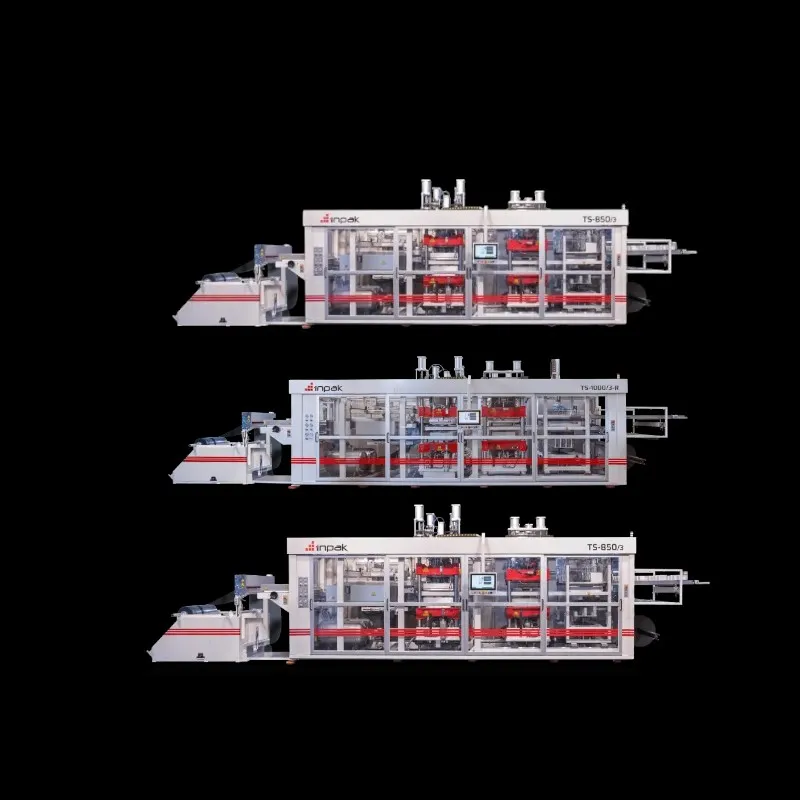
INPAK stands at the forefront of thermoforming innovation, delivering heavy-duty, ultra-reliable packaging machinery engineered to meet the highest global productivity standards. Leveraging decades of precision manufacturing expertise, INPAK manufactures an advanced lineup of thermoformers including the high-speed TSR-800, TS-800, TS-850, and the high-capacity TS-1000, alongside heavy-duty Pre-Heaters and Elevator Conveyor Systems. In practical industrial operations, the most common situation encountered by global converters is machine performance degradation during continuous 24/7 industrial campaigns. INPAK eliminates this vulnerability by engineering every frame with gapless joints in toggle systems, long-life needle bearings, and an active backlash compensation system that takes up play between adjusting nuts and shafts under full operational clamping load.
Every INPAK machine is designed around an intelligent, ergonomic HMI interface and proprietary Inpak software, providing comprehensive machine management, visual diagnostics, and integrated remote access capabilities for immediate remote control and rapid fault finding anywhere in the world. Heating efficiency is maximized through variable heating configurations utilizing genuine HTS and HTSS Black ceramic elements that adjust dynamically according to mould index dimensions. Based on our extensive engineering experience on the shop floor, pairing INPAK’s servo-plug assist with servo-driven transport chains and screen-adjustable automatic sheet stretching delivers peerless material distribution and homogeneous wall thickness across PET, CPET, PP, PVC, PS, OPS, and bio-based PLA materials.
Reliability is further reinforced by equipping every production line with industry-leading components from premier global brands including B&R, SEW-Eurodrive, Siemens, ABB, Omron, Schneider Electric, Elstein, JWIS, Festo, SMC, SKF, FAG, INA, and Beka-Max automated lubrication systems. Downstream automation handles high-speed product flow effortlessly, offering standard A-B and A-B-C stacking variations for seamless carton packing and conveyor handoff. The most critical mistake packaging processors make is compromising on build quality and component pedigree, leading to frequent unplanned line stops and high maintenance overhead. In real-world production environments, packaging manufacturers rely on INPAK automatic thermoforming machinery to deliver unmatched cycle speeds, exceptional material efficiency, and unwavering container consistency across global markets.