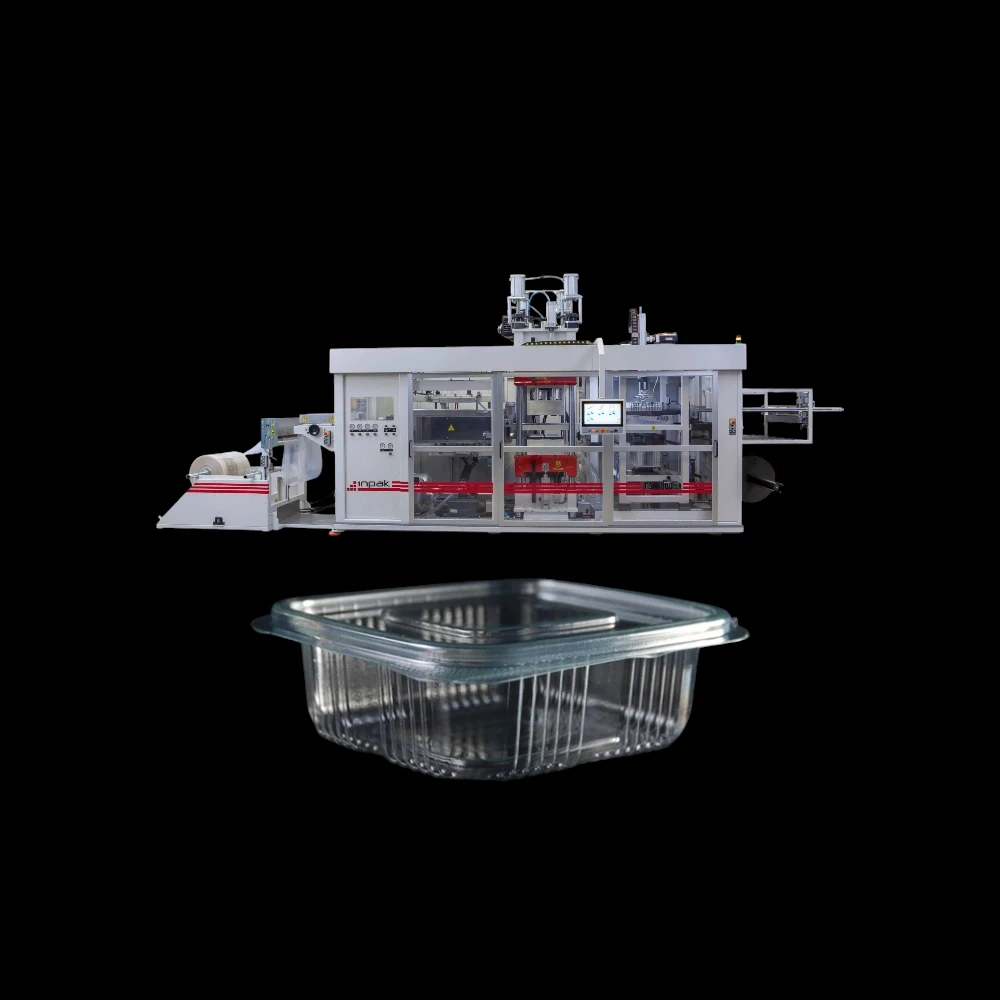
Automated Versatile Thermoforming Machine: Flexible Production for Different Packaging Applications
The modern packaging sector demands equipment that bridges high-volume efficiency with high-mix adaptability, making the automated versatile thermoforming machine the core asset for ambitious converters. Today’s dynamic supply chain leaves no room for dedicated, single-purpose machinery that sits idle whenever consumer trends pivot. Industrial setups require an integrated platform where pneumatic precision, precision servo-plug assistance, and advanced thermal distribution interact seamlessly. Integrating top-tier industrial control platforms like B&R or Siemens alongside specialized machine kinematics ensures that shifting from shallow fruit trays to deep dairy tubs occurs without sacrificing cycle speeds or structural rigidity.
Table of Contents
In practical field operations, the most common pitfall we observe is converters purchasing machinery configured exclusively for standard polymers, only to face thermal instability when suddenly tasked with running sustainable barrier materials or post-consumer recyclables. A truly capable flexible thermoforming system solves this bottleneck through modular heater arrays, such as HTS and HTSS black ceramic elements, paired with intelligent indexing algorithms. Rather than applying blunt thermal energy across the sheet, the system regulates distinct heating zones matched mathematically to the mold index, eliminating polymer degradation before forming even begins.
From an operational engineering perspective, reliable versatility means continuous production stability across varying cycle counts. Implementing gapless toggle linkages combined with long-life needle bearings prevents mechanical deflection when clamp frames compress under high tonnage. Furthermore, servo-driven transport chains with real-time automatic sheet tensioning compensate for thermal expansion during continuous running. For contract packagers handling fluctuating order volumes, this operational resilience turns volatile scheduling demands into consistent, predictable output across every production shift.

Automated Versatile Thermoforming Machine Flexible Production for Different Packaging Applications
How Turkish Thermoforming Machines Adapt to Different Packaging Requirements?
Over the past two decades, industrial machinery builders in Turkey have advanced from assembly providers to pioneering innovators in Thermoforming machine production. The technological architecture of a high-end Turkish Thermoforming machine combines heavy-duty European mechanical components with agile software ecosystems tailored to global plant conditions. Integrating Festo and SMC pneumatics with SKF and INA bearing assemblies within heavily ribbed steel chassis provides the extreme rigidity demanded by severe industrial thermoforming, positioning these units at the forefront of global packaging facilities.
When evaluating how a Turkish Thermoforming machine adapts to divergent formats, the key lies in the software-to-hardware feedback loop. Systems utilizing dedicated interfaces allow operators to modify heating profiles, mold closing curves, and plug penetration velocities directly on screen without mechanical teardowns. Our engineering experience indicates that converters often encounter excessive wall thinning when switching between different package depths. Advanced Turkish platforms counteract this through multi-stage servo-plug movements that dynamically match the sheet draw ratio in real time, guaranteeing structural integrity across demanding geometries.
For global packaging converters seeking capital efficiency without compromising technical precision, working with specialized Turkish Thermoforming machine manufacturers provides a distinct technological advantage. The integration of high-grade components like SEW drives, Omron sensors, and ABB power infrastructure guarantees that component sourcing and maintenance protocols remain seamless anywhere in the world. This hardware maturity, coupled with remote diagnostic platforms for instant tele-service and troubleshooting, transforms these platforms into highly competitive assets across diverse, demanding conversion environments.
From Food Trays to Disposable Cups: Exploring Versatile Thermoforming Machine Applications
Packaging operations running diverse product portfolios require food packaging machines engineered to handle extreme variations in draw depth, cycle kinetics, and stacking kinematics. Converting shallow meat trays requires minimal mechanical stroke but intensive sealing-flange calibration, whereas deep disposable drinking cups demand rapid, deep plug penetration and high-volume compressed air evacuation. Modern plastic thermoforming systems navigate these contrasting mechanics through programmable platen motions that allow converters to tailor forming dynamics down to the millisecond.
| Packaging Item | Material Dynamic | Forming Challenge | Kinematic Solution |
| Meat and MAP Trays | Multi-layer PET/PE | Flange flatness and seal integrity | High toggle clamp force |
| Deep Cold Cups | Homopolymer Polypropylene | Side-wall thickness balance | Dynamic servo-plug assist |
| Hinged Clamshells | OPS and Recycled PET | Hinge brittleness and cracking | Precision index heating |
In day-to-day conversion environments, common technical failures frequently occur during the post-forming stages rather than forming itself. Inexperienced operators often focus solely on the mold cavity, overlooking the stacking process. Disposable cups require distinct continuous ejection systems, whereas hinged bakery containers demand precise count-and-nest mechanisms. Modern multi-station Thermoforming machines integrate automated downstream stackers supporting A-B or A-B-C nesting configurations as standard. This robotic stacking infrastructure eliminates manual handling, preventing deformation in thin-walled consumer packaging while optimizing labor efficiency.
For manufacturing operations balancing retail display aesthetics with protective industrial shipping containers, achieving multiple product applications requires extreme tooling compatibility. Switching between rigid barrier trays and lightweight transparent lids is accomplished through balanced pneumatic venting and precision clamping tables. By maintaining precise toggle adjustments that take up mechanical play under peak load, the tooling platens remain parallel, ensuring that food trays seal hermetically and drinking cups maintain rigid, leak-proof rim geometry across long operating runs.
Why Production Flexibility Matters When Choosing a Thermoforming Machine Manufacturer?
When vetting international Thermoforming machine manufacturers, assessing baseline mechanical tonnage is insufficient; procurement teams must audit a builder’s engineering philosophy regarding agile manufacturing. A manufacturing plant locked into rigid machinery platforms faces steep downtime costs whenever clients revise packaging dimensions or request novel container chemistries. A forward-thinking Thermoforming machine supplier designs kinematics around high-mix, variable-capacity manufacturing, ensuring the base equipment readily accepts distinct tool profiles, third-party cutting dies, and secondary automation units.
Our field audits reveal that the primary error converters make during equipment acquisition is prioritizing top-speed cycle ratings over mechanical adaptability. A machine optimized solely for blistering dry cycles often lacks the modular structural rigidity needed to form complex industrial clamshells or handle high-viscosity biopolymers. Working directly with proactive Turkey Thermoforming machine manufacturers mitigates this commercial risk, as equipment designs prioritize broad forming envelopes, dynamic vacuum balancing, and modular servo plug stations capable of absorbing fluctuating client demands seamlessly.
Long-term commercial resilience hinges on sustainable production flexibility that protects operational margins against shifting market forces. As regulatory policies mandate lightweighting and increased recycled polymer ratios, thermoforming platforms must adjust forming dynamics without requiring capital-intensive retrofits. Selecting a supplier that builds gapless toggle systems, integrates universal tool mounting plates, and deploys scalable control architectures ensures that your operational footprint easily accommodates whatever packaging format or material blend the market demands next.
PET, CPET and PP Packaging: Material Compatibility in Turkish Thermoforming Machines
Processing distinct thermoplastic resins requires specialized thermal regulation and dynamic chain management to prevent sheet sagging and crystalline structural defects. Amorphous PET and bio-based PLA demand ultra-precise thermal windows to maintain clarity without embrittlement, whereas crystalline CPET requires sustained high heat for oven-safe applications. Conversely, polypropylene presents a narrow processing window where material sagging must be actively counteracted. A premier Turkish Thermoforming machine manages these conflicting polymer behaviors by coupling independent top and bottom ceramic heating zones with automated sheet stretching mechanisms directly controlled from the HMI.
| Resin Type | Thermal Behavior | Processing Hazard | Control Mechanism |
| APET and RPET | Rapid glass transition | Haze formation and embrittlement | Balanced radiation profiling |
| CPET | High crystalline growth | Thermal distortion under heat | High-temperature ceramic banks |
| Polypropylene (PP) | Narrow melting window | Severe sheet sag into heaters | Automated chain stretch system |
| PLA Biopolymers | Heat sensitive melt | Rapid polymer degradation | Micro-zone ceramic heating |
In real-world shop-floor execution, running polypropylene on older or rigid platforms consistently generates severe thickness variations across product corners. Our technical field experience shows that when converters fail to utilize dynamic, servo-driven sheet tensioning during the heating phase, PP sheets sag into lower heater banks, causing scorching and uneven wall distribution. Advanced plastic packaging machines incorporate continuous optical or mechanical sag sensors that trigger compensating chain expansion, maintaining an exceptionally flat sheet profile directly up to the moment of mold entry.
For packaging producers handling food and consumer goods, cross-material compatibility translates directly into bottom-line profitability. Equipment engineered with heavy-duty chain rails, integrated pre-heaters, and automated lubrication systems handles abrasive APET, high-temperature CPET, and soft polyolefins without hardware changeovers. This material agnosticism allows converting plants to pivot swiftly between clear blister packs, heat-resistant ready-meal trays, and cost-effective PP dairy tubs on a single machine asset, drastically reducing structural overhead.

Automated Versatile Thermoforming Machine Flexible Production for Different Packaging Applications
Pressure-Assisted Thermoforming for Packaging Designs with Different Shapes and Depths
Vacuum forming alone often fails when producing intricate packaging with sharp aesthetic contours, structural reinforcing ribs, or deep draw ratios. Integrating high-volume air pressure thermoforming technology solves these geometrical constraints by introducing pressurized air up to 6 bar into the forming box simultaneously with vacuum evacuation. Operating a high-performance pressure forming machine ensures that heated plastic is driven instantaneously into the micro-cavities of the mold, creating crisp definition on structural ribbing, complex snap-fit lids, and deep-draw compartments.
| Process Variable | Standard Vacuum Forming | Pressure-Assisted Thermoforming |
| Forming Differential | Atmospheric limit up to 1 bar | Compressed air assistance up to 6 bar |
| Geometric Definition | Rounded corners and soft detail | Razor-sharp contours and crisp ribbing |
| Material Distribution | Thick bottom base, thin sidewalls | Highly uniform corner and wall profile |
| Cavity Infill Rate | Slower, dependent on vacuum draw | Instantaneous pressurized distribution |
From an operational standpoint, running deep-draw containers under pressure-assisted thermoforming parameters introduces significant mechanical stresses on platen clamping tables. In practical production, the most severe error operators make is applying maximum air burst before the servo-plug has fully descended, causing premature sheet chilling and severe bottom thin-out. Utilizing an advanced thermoforming machine with air pressure allows the technician to fine-tune the millisecond delay between plug descent, vacuum activation, and positive air injection, guaranteeing that the sheet stretches homogeneously throughout the cavity depth.
Applying a controlled air pressure forming process empowers packaging engineers to push down material gauges without sacrificing container rigidity. By forcing the molten polymer precisely into structural corners and load-bearing geometries, structural stiffness is achieved via geometry rather than sheet thickness. This capability is critical for lightweight medical trays, cosmetic presentation packs, and compartmentalized food containers, providing high structural resilience alongside substantial raw material cost savings.
How Automated Thermoforming Machines Support Faster Product Changeovers?
In contemporary contract manufacturing, operational downtime during tool transitions erodes profitability faster than slow cycle rates. Deploying an automated versatile thermoforming machine reduces tool changeover intervals from multiple hours down to brief, standardized windows. Modern automation encompasses motorized mold height adjustments, pneumatically clamped tool assemblies, and pre-saved operational recipe configurations. When the mechanical setup relies on automated adjustments rather than manual technician input, mechanical alignment errors are eliminated, allowing the line to resume high-speed production safely.
A critical engineering vulnerability during tool changeovers is the mechanical toggle drive mechanism and adjusting shaft interfaces. Under repetitive high-tonnage cycling, play develops within mechanical joints, leading to platen misalignment and cutting blade dulling on steel-rule or in-mold punch tooling. Leading manufacturers prevent this by integrating automatic systems that take up the play between adjusting nuts and drive shafts when under load. Coupled with automated chain rail positioning, tooling swaps become precise, repeatable operations managed seamlessly through intuitive digital presets.
| Machine Parameter | Traditional Manual Setup | Automated Inpak System | Operational Impact |
| Platen Height Calibration | Manual shimming and tuning | Motorized digital adjustment | Zero platen angle mismatch |
| Thermal Zone Balancing | Trial-and-error manual dials | Stored digital recipe recall | Instantaneous thermal stability |
| Rail Width Positioning | Mechanical hand crank setup | Screen-controlled automation | Eliminated chain binding |
| Lubrication Maintenance | Manual grease gun rounds | Continuous automated lube | Extended toggle service life |
Our practical plant audits indicate that scrap material generation during changeovers occurs primarily while dialing in thermal settings. Modern automated platforms resolve this by storing complete heating grid profiles, indexing lengths, plug assist travel curves, and ejection parameters within the machine software. Recalling a saved recipe automatically adjusts the HTS ceramic heating elements to match the exact mold index required, allowing operators to achieve sellable, high-precision packaging within the first few dry cycles of restarting the line.
Choosing a Thermoforming Machine for Multiple Packaging Formats and Production Needs
Selecting the optimal industrial thermoforming platform requires evaluating mechanical drive kinematics, platen clamping forces, forming areas, and downstream integration. Plant managers must identify equipment capable of transitioning smoothly across varied commercial formats, such as shifting from shallow multi-cavity egg cartons to high-depth deli containers. Prioritizing versatile forming capabilities ensures your production facility handles diverse physical configurations without requiring auxiliary forming units or specialized custom framing for every new contract.
| Strategic Requirement | High-Versatility Machine Platform | Single-Purpose Rigid Machine |
| Production Mix | High-mix, variable run packaging | Fixed-dimension commodity runs |
| Polymer Flexibility | APET, CPET, PP, PS, PVC, PLA | Dedicated single resin processing |
| Tooling Interchange | Rapid universal tool mounting | Custom dedicated tool brackets |
| Business Adaptability | Rapid response to market trends | High capital risk on format change |
When structuring a capital acquisition, many buyers mistakenly focus solely on the initial machine quote rather than reviewing total operating consumption and tool flexibility. A machine lacking robust mechanical frameworks—such as heavy toggle systems and high-precision servo controls—will exhibit platen deflection under sustained high-speed cycles, destroying expensive tooling prematurely. It is crucial to verify that the forming station, cutting press, and stacking unit are synchronized by high-speed industrial network fieldbuses to prevent cumulative tracking errors during rapid indexing.
Investing in customized packaging solutions supported by fully automated kinematic platforms provides contract manufacturers with enduring commercial resilience. Equipment that integrates universal tool clamping, expansive forming windows, and precise sheet-level diagnostics allows converters to scale operations efficiently. Whether running high-volume thin-wall cups or heavy-gauge protective consumer blister packs, a well-engineered thermoformer delivers repeatable part dimensions, smooth perimeter cuts, and reliable finished stacks across years of multi-shift operation.
What Makes Turkish Thermoforming Machine Manufacturing Suitable for Global Packaging Markets?
The international ascent of Turkish Thermoforming machine manufacturing is grounded in robust mechanical fabrication, modern digital controls, and adherence to rigorous global engineering standards. Machine builders in Turkey utilize premier international components—incorporating drive systems from SEW and Siemens, pneumatic controls from Festo, and precision bearings from SKF and FAG—ensuring exceptional operational reliability. This deliberate approach gives global packaging enterprises complete confidence that replacement components, software architectures, and mechanical standards match those of legacy Western European equipment.
| Component Group | Manufacturer Brands Deployed | Operational Advantage |
| Motion and Drives | B&R, SEW, Siemens, ABB | Global field service availability |
| Pneumatics and Sensors | Festo, SMC, Omron | Standardized replacement worldwide |
| Mechanical Bearings | SKF, FAG, INA, JWIS Chains | Extreme operational load endurance |
| Ceramic Heating Banks | Elstein HTS and HTSS Elements | Precision localized thermal control |
A core competitive strength that global packaging converters value is the rapid engineering agility offered by high-tier Turkish manufacturers. While traditional European suppliers often impose rigid, non-negotiable machine configurations with protracted delivery schedules, Turkish machinery builders actively tailor equipment to distinct plant footprints, specialized sheet thicknesses, and unique cleanroom environments. This engineering flexibility, combined with highly cost-effective build programs, maximizes return on capital investment across both emerging and established industrial packaging markets.
Industrial packaging facilities running continuous multi-shift operations require immediate technical support to maintain line uptime. Leading Turkish machinery manufacturers address this by integrating secure industrial IoT gateways, enabling remote diagnostics, software upgrades, and immediate fault resolution from centralized support centers. This real-time troubleshooting capability, backed by a wide availability of standardized components, ensures converting plants in North America, Europe, or Asia run continuous production with minimal unplanned technical downtime.
From Prototype to Mass Production: The Role of Versatile Thermoforming Technology
Taking a conceptual packaging geometry from an initial pilot run to continuous industrial-scale manufacturing requires precision thermoforming hardware that maintains dimensional accuracy across varying output volumes. In early development, engineering teams run pilot molds to test structural venting, corner thinning, and hinge integrity. Utilizing a multi-format thermoformer allows process engineers to establish stable temperature profiles, dynamic plug timing, and vacuum pressure curves during trial runs, which transition smoothly into high-volume, multi-cavity production runs.
| Phase of Production | Engineering Focus | Machine Control Parameter |
| Prototyping | Material flow and draft validation | Manual parameter and stroke tuning |
| Pilot Tooling Validation | Shrinkage factors and seal stability | Stored recipe optimization |
| Mass Commercial Run | High cycle rate and stacking speed | Full servo-synchronized kinematics |
A common breakdown during commercial scale-up is the physical mismatch between single-cavity prototype tools and large multi-cavity production master platens. If the industrial machine lacks precise servo plug assistance or exhibits uneven thermal radiation, parts running at the perimeter of the web display severe dimensional variance compared to center cavities. True machine versatility guarantees uniform thermal saturation across the entire sheet surface, ensuring that every package, regardless of its position in a 40-cavity tool, matches the approved quality standard.
Accelerating time-to-market demands deep integration between machine mechanics, sheet transport, and in-line trimming stations. Utilizing a rigid thermoforming system featuring precise servo-driven indexing and gapless toggle clamping guarantees that parts are formed, perimeter-cut, and nested without mechanical distortion. This kinematic accuracy protects thin wall sections and precision seal surfaces, allowing packaging converters to move rapidly from functional prototyping to high-speed commercial production without experiencing costly tooling modifications.

Automated Versatile Thermoforming Machine Flexible Production for Different Packaging Applications
INPAK: Turkish Thermoforming Machine Manufacturing for Flexible Packaging Production
INPAK has established a distinguished position within the global packaging machinery sector, engineering high-performance automated solutions tailored specifically to modern manufacturing demands. The comprehensive machine portfolio—spanning the TSR-800 Thermoforming Machine, TS-800 Thermoforming Machine, TS-850 Thermoforming Machine, and the expansive TS-1000 Thermoforming Machine—delivers high-speed output, precision servo controls, and exceptional production adaptability. Supported by dedicated auxiliary systems like the Pre-Heater Thermoforming Machine for demanding materials and integrated Elevator Conveyor System for Thermoforming Machine automation, these platforms optimize manufacturing across food, medical, and industrial consumer markets.
| Machine Model | Forming Area Capacity | Drive Architecture | Target Industry Application |
| TSR-800 Series | High-Speed In-Mold Cut | Full Servo Linkage | Ultra-high volume thin wall cups |
| TS-800 Series | Standard Industrial Format | Servo-Plug Assist | Multi-cavity food and bakery trays |
| TS-850 Series | Extended Width Platform | Micro-Zone Ceramic Heat | Deep-draw and large-format blisters |
| TS-1000 Series | Maximum Output Platform | Heavy-Duty Gapless Toggles | High-capacity industrial containers |
Every INPAK installation is constructed around robust mechanical engineering and premier global components, incorporating industrial hardware from B&R, SEW, Siemens, ABB, Omron, Schneider, Elstein, JWIS, Festo, SMC, SKF, FAG, INA, and BEKA-MAX. The advanced INPAK software environment, combined with ergonomic human-machine interfaces and secure remote diagnostics, provides operators with complete process control and instantaneous fault resolution. Featuring HTS and HTSS black ceramic heating arrays, servo-driven transport chains with automated on-screen stretching, and gapless needle-bearing toggle linkages, each machine maintains mechanical precision under high-tonnage continuous operation.
To ensure pristine handling of completed containers, INPAK thermoformers incorporate versatile downstream stacking automation supporting A-B and A-B-C nesting variations as standard. Automatic lubrication networks continuously protect critical chain and toggle mechanisms, while active anti-play adjusting systems eliminate mechanical variance between shafts and adjusting nuts during peak loads. By uniting advanced mechanical precision with modern digital automation, INPAK delivers high-efficiency machinery that empowers packaging converters worldwide to maximize productivity, adapt to changing market requirements, and achieve outstanding manufacturing performance.